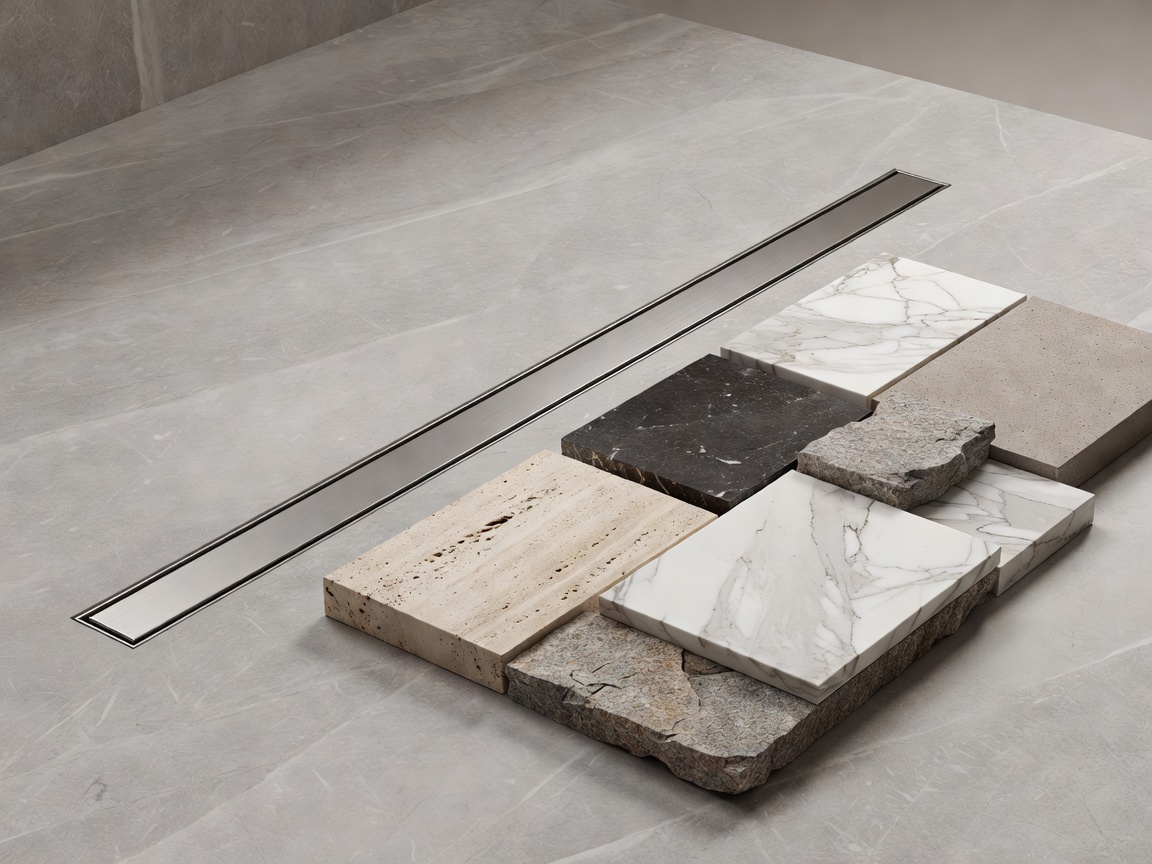
Specify a location, not just a material
A stone suitable for a dry resting wall may be unsuitable for a wet barefoot floor or a heated bench. Write the exposure first: splash, immersion, steam, heat, cleaning chemicals and expected traffic. Then ask for product-specific evidence that matches that location. Generic descriptions such as “spa grade” or “luxury finish” do not explain performance. Natural variation, fabrication details and installation methods can change the result. Retain agreed samples and technical data, but recognise that a small sample cannot demonstrate drainage, junctions or the feel of a complete room.
Treat slip behaviour as a design question
A safe floor depends on more than texture. Water, soap, oils, gradients, transitions, cleaning and the way people move all influence slipping. Ask for relevant test information and an assessment appropriate to barefoot wet use. BS EN 16165 describes methods for evaluating pedestrian surface slip resistance; results from different methods should not be casually treated as interchangeable. The Health and Safety Executive also publishes guidance on assessing slip risks. A rating from a brochure is a starting point, not a guarantee. Evaluate the exact finish and expected contamination, including how cleaning changes the surface over time.
Understand the supporting assembly
Tiles and grout are not a substitute for waterproofing. The substrate needs appropriate stiffness, preparation and compatibility with the specified membrane and adhesive. Large-format finishes make flatness, coverage and handling especially important. Natural stone may introduce sensitivity to moisture, staining or adhesive chemistry. BS 5385 offers relevant guidance on wall and floor tiling, while BS EN 14891 addresses liquid-applied water-impermeable products beneath bonded ceramic tiling. These references do not make every product suitable for steam exposure. Obtain written confirmation for the actual assembly, operating conditions and installation sequence.
Steam rooms create particularly demanding conditions for adhesives, sealants, boards and vapour-control layers. Avoid substituting products on site because their packaging uses similar terminology. The system supplier should identify compatible components, preparation, application limits, curing and inspection requirements. Record concealed work before covering it, including penetrations and membrane connections. If products from different manufacturers are combined, make responsibility for compatibility explicit. A warranty attached to one material does not necessarily cover the complete installation or the consequences of an unsuitable adjoining layer.
Resolve movement and drainage together
Movement joints are part of the design, not imperfections to hide after installation. Structure, thermal change and different materials can move differently. Coordinate joint locations with the substrate, room geometry and supplier guidance rather than making grout lines dictate every decision. At drains, show how the waterproofing connects to the drainage body and how the finish terminates without trapping water. Confirm the build-up depth before ordering a shallow channel. At benches and shelves, avoid accidental backfalls or pockets that remain wet. Removable grates and strainers must remain removable after finishing.
Choose a realistic cleaning relationship
Natural stone may require careful product selection and periodic treatment, while highly textured porcelain can need more deliberate soil removal. Resin-based finishes depend on system chemistry, installation quality and exposure limits. Timber in a sauna has different thermal and maintenance considerations from timber in a splash zone. None is universally maintenance-free. Ask for approved cleaning methods, prohibited chemicals and repair options before procurement. If the household routine cannot support the required care, choose another finish. A material that stays attractive only under an unrealistic regime is not a durable specification for that home.
Compare properties rather than appearances
The table below is a briefing aid, not a product approval. Confirm the exact material, test evidence and system compatibility for each proposed location. A honed stone, polished stone and textured stone from the same geological family can behave very differently. Likewise, one porcelain range cannot stand in for every porcelain product. Use the comparison to ask more precise questions, and keep aesthetic preferences separate from unresolved technical conditions until those conditions have been checked.
| Finish family | Potential advantage | Check before specifying | Care implication |
|---|---|---|---|
| Porcelain | Broad surface and format choice | Exact slip evidence, edge details and adhesive system | Texture and grout affect cleaning effort |
| Natural stone | Variation and substantial tactile character | Water sensitivity, heat exposure, staining and finish | Use stone-compatible products; assess treatment needs |
| Resin system | Potential for fewer visible joints | Wet-use approval, substrate movement and repair method | Observe chemical and abrasion limits |
| Sauna timber | Comfort in an appropriate dry-heat assembly | Species, surface temperature, fixings and supplier approval | Dry correctly; inspect and clean as instructed |
Mock up the difficult junction
Build a sample that includes a corner, drain edge, sealant joint and representative lighting. Review it wet where appropriate and inspect how it can be cleaned. Check whether replacement parts and matching spare material can be stored without creating a new burden. Agree acceptable visual variation and workmanship before the whole room is installed. The purpose is not to eliminate every natural mark; it is to make the intended standard measurable. Good detailing lets the serene finish remain the visible result of a coherent, inspectable construction system.